Does your child need constant reminders to stay on task?
Do they forget instructions moments after hearing them?
Perhaps they are bright and capable, but completing homework, organizing their belongings, or staying focused seems much harder than it should.
Many children experience difficulties with attention, organization, and self-regulation at different stages of development. However, when these challenges persist and affect a child’s daily life at home, at school, or with friends, parents may wonder whether ADHD could be playing a role.
An ADHD assessment can help answer these questions by providing a clearer understanding of your child's unique strengths, challenges, and needs. But what exactly does an ADHD assessment involve, and how can it help your child?
What is an ADHD Assessment?
An ADHD assessment is a comprehensive evaluation that explores a child's attention, activity level, impulse control, and executive functioning. It evaluates how challenges may be affecting a child’s functioning at home, at school, and in other everyday settings.
Rather than looking at individual symptoms, an assessment considers all the factors that may influence a child’s learning, behaviour, and daily functioning.
What is the Difference Between ADD and ADHD?
In the past, ADD and ADHD were often described separately: ADD referred to attention difficulties without hyperactivity, while ADHD included hyperactivity. Today, ADD is no longer a formal diagnosis. ADHD is the umbrella term and includes three presentations, previously called subtypes: predominantly inattentive, predominantly hyperactive-impulsive, and combined.
- Predominantly Inattentive Presentation: Children may have difficulty staying focused, following instructions, remembering information, or keeping track of their belongings. They may become easily distracted, forgetful, or seem to daydream frequently.
- Predominantly Hyperactive-Impulsive Presentation: Children may have difficulty sitting still, frequently move or fidget, talk excessively, interrupt others, or act before thinking. They may seem to be constantly on the go.
- Combined Presentation: Children experience a combination of inattentive and hyperactive-impulsive symptoms. They may struggle with both staying focused and managing their activity level or impulses.
What Might ADHD Look Like in Children?
ADHD can affect children in different ways, and some difficulties may be more noticeable than others.
ADHD may affect children in several areas of everyday life, including:
- Attention: easily distracted, overlooking details
- Impulsivity: acting before thinking, interrupting others, difficulty waiting their turn
- Activity level: appearing as if they are on the go, fidgeting, difficulty remaining seated
- Organization: struggling to keep track of belongings
- Working memory: difficulty remembering instructions, hard time keeping track of multiple steps
- Executive functioning: struggling with planning, time management, getting started on tasks
- Task completion: having difficulty following through on an assignment or activity
These challenges may become more noticeable as academic and organizational expectations increase. However, ADHD looks different in every child, and not all children will experience the same difficulties. Symptoms can vary depending on a child's developmental stage and individual profile.
Why is a Comprehensive Assessment Important?
Difficulty paying attention doesn't automatically mean a child has ADHD.
Similar challenges can be associated with several factors, including learning difficulties, anxiety, sleep concerns, stress, developmental differences, or other underlying factors.
The purpose of an assessment is to understand what is contributing to the child's difficulties.
Importantly, an assessment looks beyond areas of concern to recognize a child's strengths, abilities, and existing coping strategies. Understanding the whole child is essential to developing recommendations that are meaningful, appropriate, and individualized.
What Happens During an ADHD Assessment?
An ADHD assessment involves gathering information from different sources to develop a well-rounded understanding of your child's functioning. Depending on the child's age and individual needs, the assessment may include:
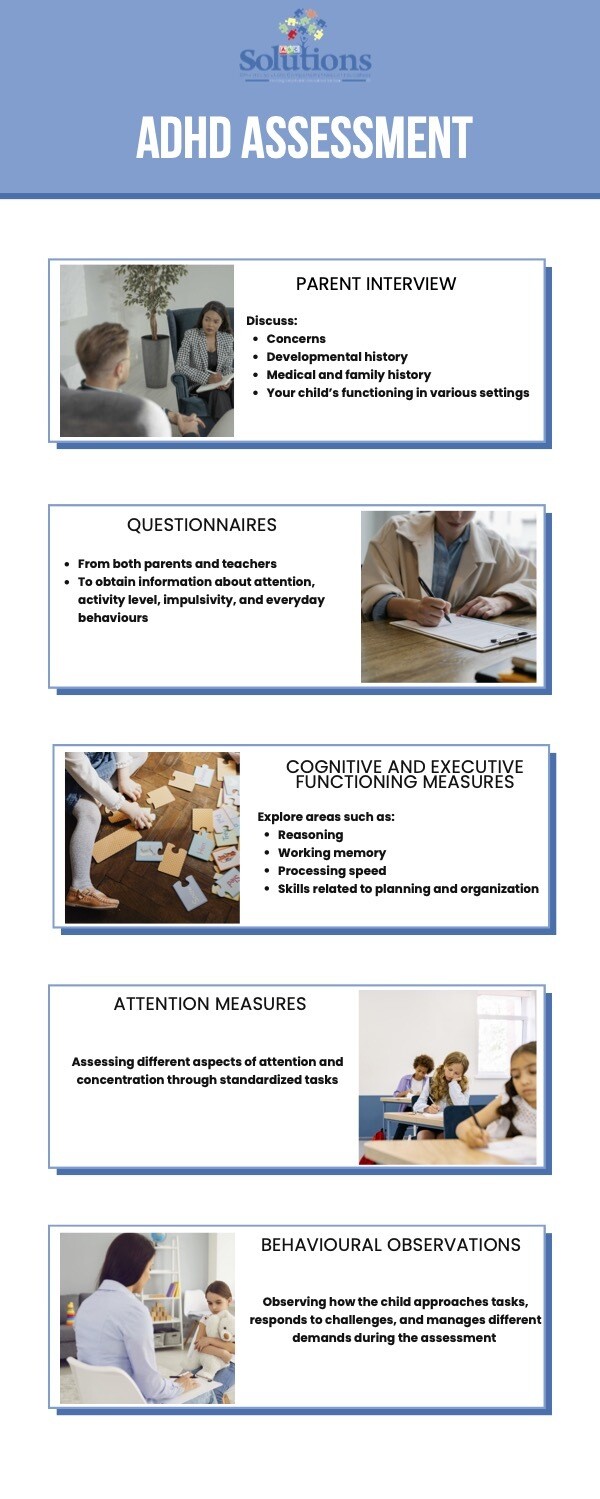
What Happens After the Assessment?
An ADHD assessment is about more than receiving a diagnosis. It is an opportunity to better understand your child's learning style, recognize their strengths, and identify the areas where additional support may be helpful.
Following the assessment, families receive a clear explanation of the findings, along with individualized recommendations for home and school.
When a child understands how they learn best, and the adults around them understand how to support them, they can begin to approach everyday challenges with greater confidence and independence.
Most importantly, an assessment can help shift the conversation from "Why is this so difficult for my child?" to "What does my child need to succeed?"
Ready to Take the Next Step?
Every child has a unique way of learning, thinking, and navigating the world. At ABC Solutions, our goal is to help families better understand their child's strengths and challenges through a comprehensive and individualized assessment process.
Meet. Connect with our team to discuss your concerns and your child's needs.
Assess. Your child completes a comprehensive assessment tailored to their individual profile.
Receive. Gain a better understanding of your child's strengths and challenges, along with individualized recommendations for home and school.
Ready to book an intake? Contact ABC Solutions to get started!
References
American Psychiatric Association. (2022). Diagnostic and statistical manual of mental disorders (5th ed., text rev.; DSM-5-TR). https://doi.org/10.1176/appi.books.9780890425787
Bélanger, S. A., Andrews, D., Gray, C., & Korczak, D. (2018). ADHD in children and youth: Part 1—Etiology, diagnosis, and comorbidity. Paediatrics & child health, 23(7), 447-453. https://doi.org/10.1093/pch/pxy109
Sparrow, E. P., & Erhardt, D. (2014). Essentials of ADHD assessment for children and adolescents. John Wiley & Sons.